



The biggest set isn’t automatically the best fit. A 20-piece stainless steel flatware set typically serves four people, with five pieces per place setting: a dinner knife, dinner fork, soup spoon, salad fork, and teaspoon. Flatware is the general term for table utensils; silverware technically refers to items made with at least 92.5 percent silver.
It’s easy to focus on finish or price and overlook how many settings you need. Choose a set size that fits your household and hosting habits, then weigh style against the care routine you’re comfortable with. This guide compares common set sizes, explains how flatware and silverware differ, and explores stainless steel options for different budgets and table styles. You’ll also find practical tips for choosing a finish and caring for your flatware, so everyday meals and special gatherings feel thoughtfully put together.
Key Takeaways
- Choose a set based on how often you host and how many pieces you want ready between washes.
- Compare the finish, weight, balance, and handle shape to find flatware that feels comfortable and suits your table.
- Learn how stainless steel grades differ, and use straightforward dishwasher habits to help keep utensils looking their best.
- Explore options across simple, traditional, and decorative styles to match your budget and dining routine.
- Bring the table together by pairing flatware with linens, napkin rings, and other coordinated accents.
Dishwasher care and rust prevention
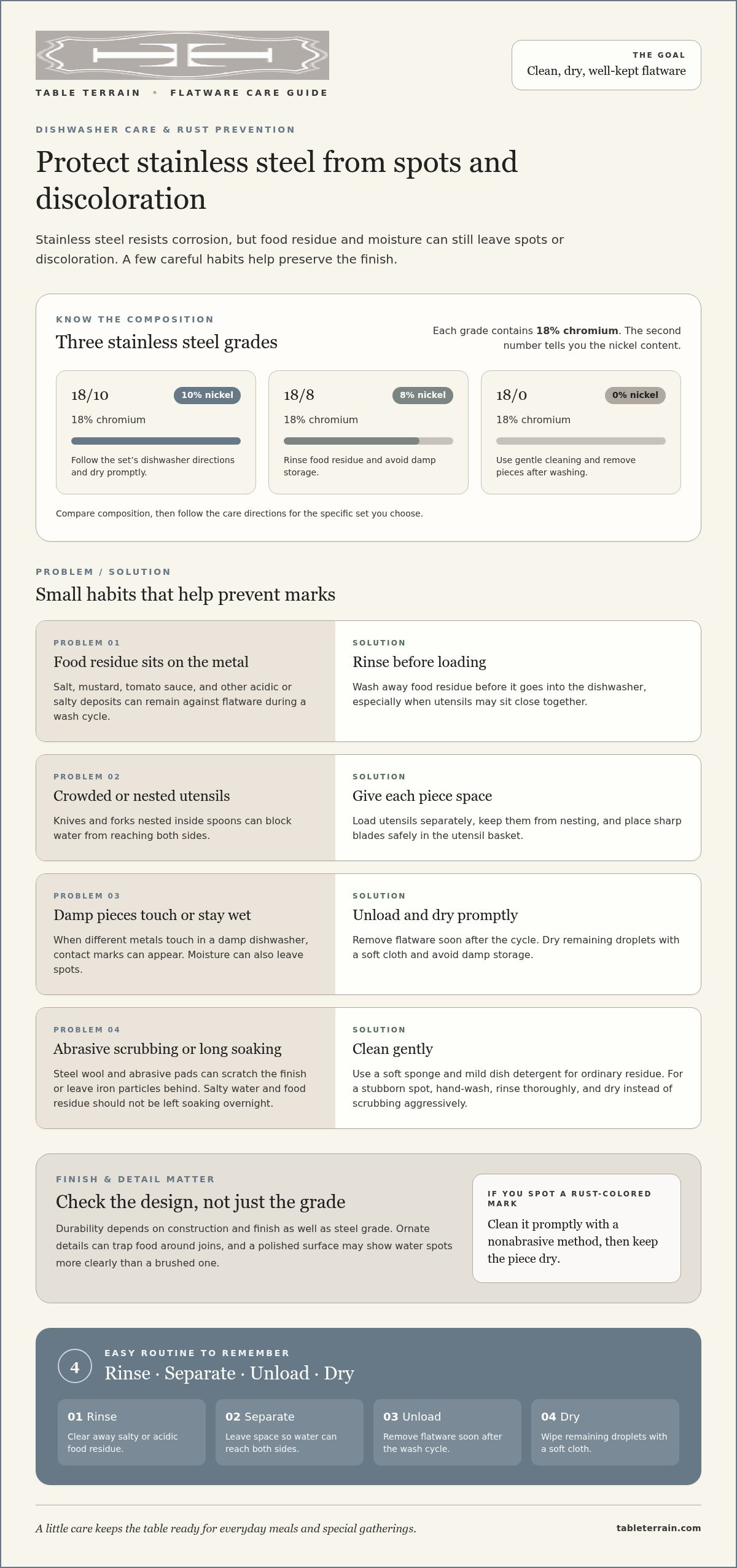
Which flatware sets are dishwasher-safe and rust-resistant? Choose stainless steel sets labeled dishwasher-safe, then follow their care directions. The grades describe composition: 18/10 contains 18% chromium and 10% nickel, 18/8 contains 18% chromium and 8% nickel, and 18/0 contains 18% chromium and 0% nickel.
Stainless steel resists corrosion, but food residue and moisture can still cause spots or discoloration. Dishwasher habits matter: before loading, rinse away salt, mustard, tomato sauce, and other acidic or salty residue. These deposits can remain against the metal during a wash cycle, especially when utensils are crowded together.
Load each piece separately so water can reach both sides. Keep knives and forks from nesting inside spoons, and place sharp blades safely in the utensil basket. When different metals touch in a damp dishwasher, contact marks can appear. Remove flatware soon after the cycle and dry any remaining droplets with a soft cloth.
| Option | Composition | Care consideration |
|---|---|---|
| 18/10 stainless steel | 18% chromium, 10% nickel | Follow the set’s dishwasher directions and dry promptly. |
| 18/8 stainless steel | 18% chromium, 8% nickel | Rinse food residue and avoid damp storage. |
| 18/0 stainless steel | 18% chromium, 0% nickel | Use gentle cleaning and remove pieces after washing. |
Choose the grade that suits your preferences, then follow its care instructions as part of your routine.
For everyday care, skip abrasive pads and steel wool, which can scratch the finish or leave iron particles behind. A soft sponge and mild dish detergent remove ordinary residue. If a spot remains, wash the piece by hand, rinse thoroughly, and dry it instead of scrubbing aggressively. Don’t leave utensils soaking overnight in salty water or food residue.
Durability depends on construction and finish as well as steel grade. A polished surface may show water spots more clearly than a brushed one, while ornate details can trap food around joins. After a meal, separate serving pieces from smaller utensils, rinse them, and load with space between each item. Clean rust-colored marks promptly using a nonabrasive method, then keep the piece dry. Regular rinsing, careful loading, and prompt drying help preserve the finish through routine dishwasher use.
Flatware set recommendations by style and use
How do 18/10, 18/8, and 18/0 stainless steel flatware compare? The first number represents chromium content: all three contain 18%; the second represents nickel, with 10%, 8%, and 0%, respectively. Use those grades to compare composition, then choose by finish, feel, and the way you’ll use each set.
Which brands offer the best warranties on stainless steel flatware? A useful warranty clearly explains what it covers, its exclusions, and how to make a claim. Compare the written terms instead of assuming a familiar brand name means better coverage.
Match the design to your table and routine. A clean, narrow handle suits a modern setting, while a beaded edge or engraved detail adds definition to a traditional table. For frequent everyday meals, prioritize a comfortable shape that’s easy to clean. For occasional hosting, a more decorative profile can make the place setting feel considered without dictating the rest of your table décor.
| Use or style | What to look for | Practical test |
|---|---|---|
| Everyday dining | Simple lines and an easy-to-clean finish | Hold a fork and spoon as you would during a meal. |
| Traditional table | Beaded, engraved, or softly curved details | Check that the pattern complements your plates. |
| Modern table | Straight lines and restrained detailing | Set one place to assess the overall silhouette. |
| Regular entertaining | A coordinated set with enough matching serving pieces | Review the included pieces before choosing. |
Use this comparison to narrow your options, but don’t rely on descriptions alone. A simple handling test can reveal balance and comfort: pick up the dinner fork, turn it naturally, and check whether the handle feels secure. Repeat with the knife and spoon. Examine the join between handle and working end, where uneven edges or awkward transitions can affect the feel.
For a considered choice, compare listed piece count, grade, finish, and care directions side by side. Don’t treat “tested” as a guarantee that a set will suit every table; testing is most useful when you know what you’re assessing. Check whether it feels comfortable in hand, matches your plates, and suits your dishwasher routine. If you like the style but not the included pieces, look for a coordinated option that better fits your usual meals.
After narrowing the choices, pair the look with flatware and serving items that complement your table’s mood. A restrained finish can anchor patterned dishes, while decorative handles stand out against simple linens.
Compare each set’s listed piece count and price with the pieces you expect to use.
Is there a difference between flatware and silverware?
Flatware is the general term for forks, knives, and spoons; silverware can describe utensils made with silver. At least 92.5 percent silver must be used in manufacturing for an item to be classified as silverware. Stainless steel is a practical everyday choice, silver-plated pieces add a silver surface over another metal, and plastic utensils are lightweight alternatives.
Comfort depends on more than heft. Hold a dinner fork as if you’re eating and notice where its weight rests. A well-balanced piece feels steady between the handle and tines, rather than pulling toward either end. Try the knife, too: the grip should feel secure while the blade moves naturally across a plate.
Handle shape matters throughout a meal. A broad, flat handle may feel stable in one hand, while a slim, rounded handle may suit another. Check for smooth edges, especially where the handle meets the bowl or blade. A raised seam, for example, can feel distracting when you hold a teaspoon repeatedly.
- Stainless steel: A durable choice for regular meals, with a solid-metal feel and varied finishes.
- Silver-plated: A decorative option with a silver surface that needs careful handling to preserve its finish.
- Plastic: Light and convenient for casual settings, though it lacks the weight and feel of metal utensils.
Use a simple side-by-side test before choosing. Pick up the dinner fork, spoon, and knife from each set. Mimic cutting a bite, lifting soup, and holding the fork upright. Notice whether the handles press into your fingers or feel awkward to turn. A set that looks refined on the table should feel comfortable in use, too.
Weight is personal, so don’t assume heavier means better. A substantial fork can feel reassuring, while a lighter spoon may be easier to maneuver over a long dinner. Balance also depends on proportions: a wide handle with a small spoon bowl feels different from a narrow handle with a broader bowl. Test the full trio, not just one piece.
Finally, match the material to your routine. Choose stainless steel for regular use, silver-plated flatware when its shine and care needs suit the occasion, or plastic for an informal meal where easy cleanup matters. Comfort depends on how each utensil sits in your hand, so compare the shapes before deciding.
Budget, splurge, traditional, large, and gold flatware options
Compare each option by piece count, design, and how often you’ll use it. A smaller set can cover daily meals, while a larger or more decorative one may suit frequent hosting better.
Budget Flatware
Budget flatware focuses on essential pieces and straightforward styling. A 16-piece set serves four, while a 20-piece set typically serves four with a fuller place-setting selection. Compare what each box includes before deciding: a lower piece count may omit serving pieces, while a larger count can add useful extras. For everyday dining, prioritize a comfortable grip and a finish that fits your routine over ornate detailing.
Traditional Flatware
Traditional flatware adds visual detail through beaded borders, engraved motifs, or curved handles. Those features create a more formal impression than plain, streamlined pieces, especially alongside simple plates. Compare the pattern with your existing dishes and linens, then consider whether you’ll use it for everyday meals or save it for gatherings. A cohesive design matters more than matching every decorative detail.
Large Flatware Sets
A larger set can help households prepare for guests without mixing different patterns. For example, a 61-piece set is listed for service for eight, while a 30-piece set is listed for service for six. Check the included inventory, not only the headline count. Extra pieces may be serving utensils or additional place settings, and that difference determines whether the set meets your needs.
If you’re splurging, focus on the qualities you’ll notice repeatedly: handle comfort, balanced weight, finish, and the precision of decorative details. A higher price doesn’t automatically make an option the right fit; choose the construction and appearance that suit your table and care habits. A refined, forged look can make a setting feel more substantial, while restrained lines work for casual and formal meals alike.
Gold-tone flatware adds warmth and contrast, especially against white plates, deep-colored linens, or clear glassware. Treat the finish as a style choice, and read its care directions before choosing it for frequent use. Picture the pieces beside your everyday dishes, then at a holiday table. If the color feels too prominent in both settings, consider a subtler accent instead.
Use this decision guide: choose a compact set for everyday meals, traditional detailing for a classic table, a larger count for hosting, or gold tones for a distinctive accent. Before buying, compare the full contents and check whether replacement pieces coordinate with your existing flatware.
Set sizes and place settings
Choose a set by counting the people you serve and the pieces you want ready. Then allow for busy meal days and unexpected guests.
Flatware Set Sizes
A 20-piece flatware set typically serves four people, making it a practical starting point for a small household. Larger sets increase the number of coordinated utensils available, but piece counts can include serving pieces or extras. Compare the stated service size with the actual inventory. That distinction helps you see whether a set adds full place settings or simply more pieces.
Place Settings
A typical place setting contains five pieces: a dinner knife, dinner fork, soup spoon, salad fork, and teaspoon. A useful household baseline is two place settings per person, so a household of three would plan for six settings. That buffer keeps clean utensils available while others are in use or waiting to be washed.
Use this quick calculation: count household members and plan for two settings per person. Then consider how often you host. If guests regularly join dinner, choose additional matching settings rather than relying on a mismatched drawer. If gatherings are occasional, a household-sized set may cover daily meals, with extra pieces added as your needs change.
- Everyday use: Start with two settings per household member, so there’s a second set of utensils available.
- Frequent hosting: Add settings for the guests you commonly serve, keeping the same pattern across the table.
- Limited storage: Compare service size and piece count to avoid buying extras you won’t use.
Read the contents list before choosing. A set’s total count doesn’t always equal its number of place settings, because serving utensils may contribute to the total. For example, a 20-piece set typically covers four five-piece settings. If the listing names serving pieces separately, count the place-setting utensils to understand how many diners it serves.
Consider your kitchen routine, too. A household that runs the dishwasher after dinner may need fewer spare settings than one that waits until the next day. Keep enough utensils for your usual routine and the meals you host most often. The right number keeps your table ready without filling storage with pieces you rarely use.
Make your count, compare each set’s service size, and choose the amount that fits your meals. Plan your place settings around the people you serve most often.
Table Terrain: Table Linens & Napkin Rings
Table Terrain helps bring your flatware choice into a cohesive tablescape with Table Linens & Napkin Rings and Flatware & Serving Items. Choose these finishing touches once you’ve settled on set size and style. A linen runner can frame place settings, while napkin rings add polish without competing with patterned dishes.
For a fuller table, pair those accents with goblets or vases that complement the flatware’s finish. Keep the palette balanced: let gold-tone utensils stand out against understated linens, or add textured napkins beside streamlined steel. Choose pieces that suit everyday meals or the gathering you’re preparing for.
Visit tableterrain.com to explore pieces for your table.
Set the tone for your next gathering
Let your flatware shape the mood of a meal, not just complete the place setting. A clean, simple finish can provide a quiet foundation for seasonal colors, patterned plates, or a favorite tablecloth. Choose one detail to build around, then let the rest of the table feel natural rather than overly matched.
That approach also makes it easier to choose stainless steel flatware sets for everyday dining that can transition to a more considered gathering. Add texture with napkins, bring in color through flowers, or use a serving piece as a subtle accent. Small choices can refresh a familiar table without requiring a complete redesign.
Table Terrain brings together Table Linens & Napkin Rings, Flatware & Serving Items, and Vases & Containers to help create a cohesive setting. Explore the pieces, or contact Table Terrain for flatware help as you plan your next table. Start with the atmosphere you want to create, and let each choice support it.
Frequently Asked Questions
What are the best stainless steel flatware sets in the US?
There isn’t one best choice for every table; compare steel grade, included pieces, and everyday feel. For a household rotation, prioritize a finish suited to your care routine and a pattern that works with your dishes. If you entertain, check whether serving pieces come in the set. For example, 18/10 contains 18% chromium and 10% nickel, while 18/0 contains 18% chromium and 0% nickel.
What is the best flatware set size for a household?
Plan for at least two place settings per person, then account for guests and your washing routine. For example, a household of four can use eight settings as a practical baseline, with more if friends often join dinner. Check the set’s service capacity rather than relying on its total piece count, since serving utensils and other extras may contribute to the advertised number.
How much do stainless steel flatware sets cost in the US?
Price depends on service capacity, steel composition, finish, and included pieces. A simple pattern and a highly detailed design may reflect different levels of craftsmanship and styling. Compare complete inventories, not just total piece counts. For a useful side-by-side assessment, note the material grade, number of place settings, finish, and whether serving pieces are included.
What are the best stainless steel flatware sets for everyday use?
Choose a set that feels comfortable during a full meal and fits your household’s cleaning routine. A restrained pattern pairs easily with changing dishes, while smooth, uncomplicated shapes are straightforward to coordinate for everyday tables. Before choosing, hold the fork, knife, and spoon together and imagine using them through a typical dinner. Confirm that the care directions fit how you usually wash and store utensils.
What should I look for when choosing flatware weight, finish, and handle design?
Look for pieces that feel balanced in your hand, with smooth edges and a comfortable grip. A mirror-like finish creates a bright look, while a brushed finish gives the table a softer effect. Compare each piece with your dishes, too. A wide handle, for instance, can feel visually bold beside delicate plates, while a slim profile creates a quieter setting.
How should stainless steel flatware be cleaned and maintained?
Follow the care directions for your specific set, and clear food residue before it dries. After washing, separate nested utensils so moisture doesn’t linger between them, then dry any remaining droplets with a soft cloth. For a stubborn spot, use mild dish detergent and a nonabrasive sponge instead of steel wool. Store clean pieces dry, especially after washing serving utensils used with salty foods.
Which brands offer the best warranties on stainless steel flatware?
Look for a warranty that clearly explains its coverage, exclusions, and claims process. Compare the written terms rather than relying on brand familiarity.