


What if the secret to a five-star dining aesthetic isn't the centerpiece, but the five seconds you spend on your linens? Most hosts find themselves frustrated when napkins look limp or clashing rings disrupt the flow of their flatware. It's a common hurdle that can make even the most expensive table feel unfinished. Mastering the use of napkin rings is the easiest way to anchor your table's texture and height, turning a simple meal into a sophisticated event.
We believe that elegant hosting should be achievable and stress-free. This guide will teach you how to use these small but mighty accents to create a curated look in under five minutes. You'll learn to pair specific folds with ring shapes and gain the confidence to mix materials like hammered gold and artisanal raffia. We'll preview the top 2026 styling trends and provide simple techniques to ensure your table always looks intentional. Get ready to transform your dining room with expert tips that balance global inspiration with practical home life.
Key Takeaways
- Learn how to elevate a flat table setting by adding necessary verticality and texture with the right finishing touches.
- Explore the 2026 trend of pairing organic materials with polished metals to select napkin rings that reflect your personal style.
- Master the art of layering textures to create a cohesive look that connects your linens seamlessly to your glassware and flatware.
- Perfect four professional folding techniques that transform ordinary napkins into intentional design elements in under five minutes.
- Identify the four essential styles every host needs to build a versatile collection and learn how to store them properly.
Why Napkin Rings are the Essential 'Jewelry' of Your Dining Table
Think of your dining table as a design canvas. You have the foundation of the table, the plates, and the flatware. But without a clear focal point, even the most expensive setting can feel two-dimensional. This is where napkin rings step in as the essential "jewelry" of your tablescape. Just as a statement necklace completes a fashion ensemble, these small accents pull disparate elements together into a cohesive story. They bridge the gap between your soft textiles and hard surfaces; creating a sense of intentionality that guests notice the moment they sit down.
In modern 2026 hosting, we've moved beyond purely functional settings toward a more curated experience. A ringed napkin adds immediate verticality to a flat landscape. Because most table elements like placemats and plates are horizontal, introducing a vertical pop of texture or shine creates much-needed visual interest and depth. Psychologically, it signals that the meal is a special event. It tells your guests that you've carefully selected every detail for their comfort, elevating a standard dinner into a truly memorable gathering.
The Functional Benefits of Using Rings
Beyond their beauty, these pieces serve a vital practical purpose. Polished wood or stone tables can be notoriously slippery; causing loose napkins to slide off laps or drift across the setting. A ring keeps your table linens organized and secure. If you're working with a smaller table, napkin rings are a lifesaver. They keep fabrics compact, leaving more room for shared platters and wine glasses. This organization ensures your linens stay crisp and don't unfold prematurely before the first course arrives.
Setting the Mood for Your Gathering
Your choice of material acts as a visual shorthand for the evening’s vibe. Polished gold rings suggest a formal, celebratory atmosphere, while acacia wood or woven raffia lean into a relaxed, organic feel. This is your opportunity to introduce a secondary accent color that ties back to your centerpiece or flatware. By selecting pieces that reflect the season, you create a sense of curated simplicity. It’s about making your guests feel pampered without the setting feeling overly stiff or unapproachable. It allows you to express your personal style through craftsmanship and texture.
Choosing the Right Materials: From Metallics to Woven Textures
Material choice defines the entire terrain of your table. In 2026, we're seeing a shift toward mixing organic textures with high-shine finishes. This contrast creates a dynamic setting that feels both grounded and luxurious. When you select your napkin rings, consider how the material interacts with your linens. Durable materials like stainless steel or treated wood are excellent for frequent hosts because they withstand repetitive use without losing their luster.
Metallic Rings for Formal Sophistication
Polished gold and silver remain the standard for high-end drama. These finishes reflect candlelight beautifully, adding a warm glow to evening meals. For a modern edge, matte black rings offer a striking silhouette against white or neutral linens. Always aim to coordinate your rings with your flatware for a seamless, professional look.
One often overlooked detail is the weight of the material. Heavy, solid metal rings require substantial, high-quality fabric to hold their shape. If you pair a heavy ring with a thin, gauzy napkin, the ring will likely slide off or look disproportionate. Match the heft of your hardware to the density of your textile for the best result.
Natural and Woven Textures for Casual Charm
If your goal is a relaxed, approachable atmosphere, turn to wood, rattan, or seagrass napkin rings. These organic materials bring a tactile warmth to the table that metal simply can't replicate. They are the perfect choice for outdoor dining or breezy summer luncheons. To create a cohesive earthy aesthetic, pair these rings with textured placemats.
Use this quick cheat sheet to guide your next gathering:
- Gold or Silver: Formal holiday dinners and milestone celebrations.
- Acacia Wood: Weekend brunches and cozy autumn gatherings.
- Woven Rattan: Alfresco lunches and coastal-themed parties.
- Matte Black: Minimalist dinner parties and industrial-chic settings.
Choosing the right material ensures your table feels intentional rather than cluttered. If you're ready to start building your own set, browse our curated collection to find pieces that resonate with your hosting style.
Coordinating Napkin Rings with Your Overall Tablescape
Great table design is never about a single item. It's about how every piece interacts to form a cohesive "table terrain." Most hosts treat the ring as an afterthought, but we view it as the essential bridge between your soft textiles and your glassware and ceramics. To master this coordination, apply the "Rule of Three": balance your color, material, and height across the entire setting. If your goblets are tall and ornate, a bold, sculptural ring prevents the napkin from looking dwarfed. This creates a landscape that feels intentional, layered, and deeply professional.
Balancing Textures with Runners and Mats
Contrast is your best friend when layering a table. If you use heavily textured runners made of linen or jute, pair them with smooth, polished metal napkin rings. The shine of the metal provides a clean visual break from the organic weave of the fabric. This strategic pairing ensures your accessories don't "get lost" against a busy pattern or a coarse textile. Visual weight is the balance between a ring's size and a napkin's thickness. A delicate, thin ring will disappear on a plush cotton napkin, while a chunky wooden ring might overwhelm a thin silk one. Always match the scale of your hardware to the heft of your linen.
Color Theory for the Dining Room
Start your design process with a clear palette. For a minimalist modern look, try a monochromatic scheme; white napkins with silver rings on a crisp white tablecloth look incredibly sophisticated. If you prefer more energy, use complementary colors to create focal points. A bold gold ring pops beautifully against deep navy or forest green napkins, drawing the eye exactly where you want it.
Your "table terrain" should also evolve with the calendar. Seasonal color shifts allow you to reuse your core napkin rings in fresh ways. Use this framework to guide your theme:
- Summer: Bright white linens with natural woven rings for a breezy, coastal feel.
- Autumn: Deep rust or ochre napkins paired with hammered copper or warm wood.
- Winter: Rich jewel tones like burgundy or emerald with high-polish silver for holiday glam.
- Spring: Pastel linens with floral-shaped or light-colored ceramic rings.
By thinking about your table as a series of layers, you ensure that every element has a purpose. This methodical approach to design doesn't just look better; it simplifies the hosting process by giving you a clear set of rules to follow for every occasion.
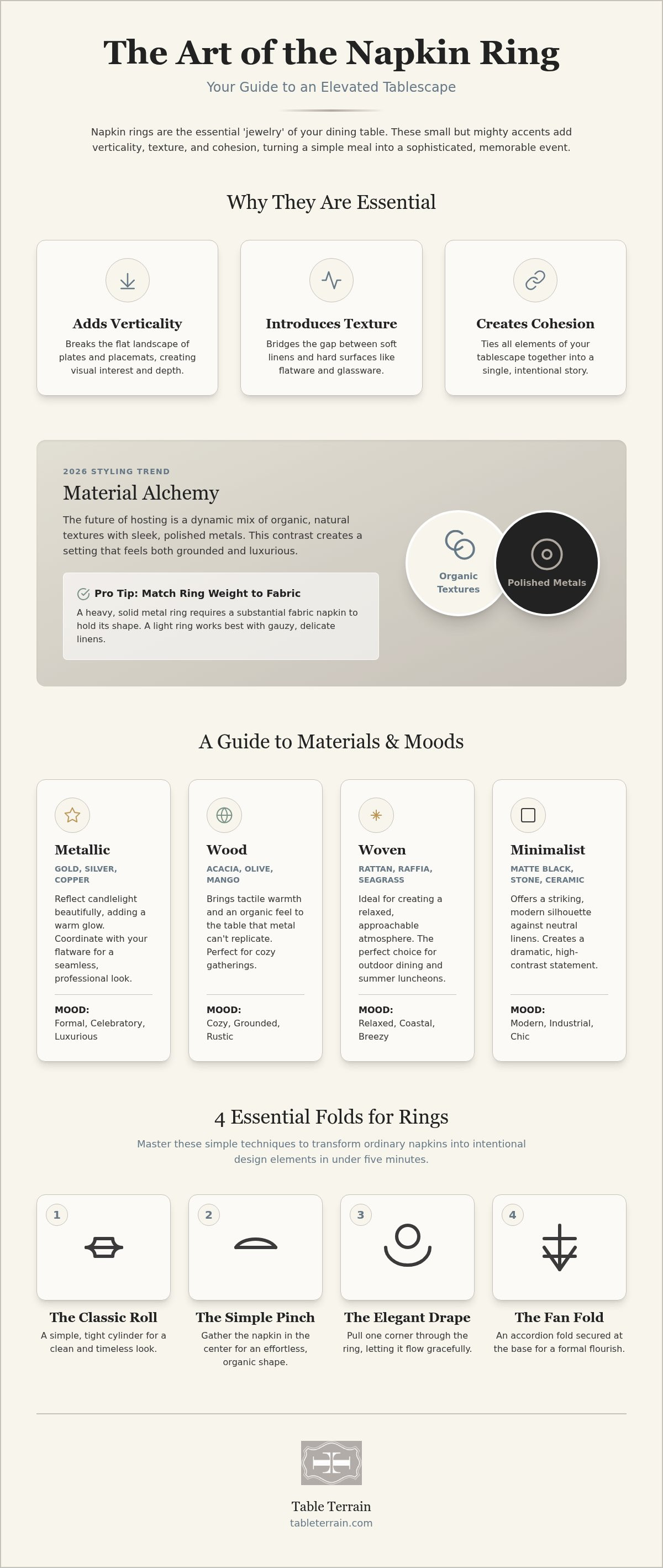
Step-by-Step: 4 Ways to Fold Napkins for Rings
The fold is the stage where your napkin rings perform. Even the most exquisite hardware can't save a wrinkled or sloppy napkin. Before you begin, ensure your linens are pressed and crisp. Heat and steam create the sharp edges needed for a professional, restaurant-worthy finish. If you're working with thin fabrics that won't stay put, try the "double-fold" trick: fold the napkin in half once more than usual to add bulk before sliding it into the ring. This prevents that "limp" look that often plagues DIY settings.
The Classic Puff (The 'Jewelry' Look)
This technique is all about volume and texture. Lay the napkin flat on your surface and pinch the exact center with your thumb and forefinger. Lift the center while pulling the corners downward to create a soft cone shape. Pull the center through the ring and fluff the edges to create a cloud-like effect. This look is best for high-volume, decorative rings with large center openings, such as beaded or oversized floral styles.
The Elegant Fan (Formal Drama)
For a setting that demands attention, the fan is the ultimate choice. Accordion-fold the napkin into a long strip, making each fold about one inch wide. Once folded, bend the strip exactly in half and slide the ring over the base where the two ends meet. This fold adds immediate height and drama. It’s the perfect partner for sleek, metallic rings that need a structured, architectural counterpart to truly shine.
The Simple Roll (Modern Minimalism)
If your aesthetic is clean and contemporary, the roll is your go-to. Fold the napkin into a neat square, then roll it tightly from one side to the other to form a cylinder. Slide the ring to the exact center of the roll. This technique is best for modern, slim rings and minimalist best table linens. It highlights the craftsmanship of the ring itself without distracting the eye with complex geometry.
The Architectural Drape (Effortless Style)
This fold works beautifully for casual brunches or outdoor dinners. Fold the napkin into a long, flat rectangle by folding it into thirds. Slide the ring up to the top third of the fabric, then lay it vertically across the plate so the bottom edge drapes slightly over the table's side. It’s a relaxed yet intentional look that works best with rings that have a larger diameter, typically between 1.5 and 2 inches.
Don't be afraid to experiment based on the ring's diameter. If your ring is tight, keep your folds sharp and compact; if it's loose, add volume with extra folds. Ready to practice your new skills? Explore our premium napkin ring collection to find the perfect match for your favorite fold.
How to Build a Versatile Napkin Ring Collection
Curation is the hallmark of a confident host. You don't need a drawer overflowing with accessories to create a stunning table. Instead, focus on building a versatile foundation of napkin rings that can transition from a casual Tuesday night to a formal holiday feast. By selecting a few "hero" pieces, you ensure your table always feels intentional and well-traveled. We recommend aiming for the "Core Four" styles: polished metallics, organic textures like wood or raffia, sculptural shapes, and seasonal accents. This variety gives you the flexibility to match any mood or menu.
Mixing different ring styles is a secret weapon for larger gatherings. If you don't have twelve matching pieces, don't worry. Using two similar styles, such as two different types of wooden rings or mixed metallic finishes, creates a "collected" look that feels more personal than a perfectly matched set. It suggests a home that has evolved over time rather than a showroom. To keep your collection in top shape, store delicate beaded or metal pieces in soft cloth pouches or divided boxes. This simple habit prevents scratches and keeps your metallics from tarnishing between events, so they're ready to shine the moment guests arrive.
Investing in 'Hero' Pieces
Your foundation starts with quality. A set of high-quality metallic rings is your most important purchase because they anchor almost any formal setting with ease. Alongside these, select a versatile "everyday" ring in a natural material like acacia wood or woven seagrass for relaxed weekend brunches. Investing in a set of 8 or 12 is safer than a set of 4 for future-proofing your collection against larger guest lists or discontinued designs. This foresight ensures you're always prepared for an unexpected plus-one without compromising your table's harmony.
Seasonal Transitions for Your Tablescape
You don't need to buy new linens for every holiday. Use your core rings to adapt your table by simply changing the napkin color or tucking a seasonal element into the ring itself. A sprig of fresh rosemary in winter or a dried lavender stem in summer transforms a standard setting into a sensory experience. This approach allows for sophisticated, personalized dining without the complexity of a full re-style. At Table Terrain, we act as your creative partner, doing the hard work of selection so you can focus on the art of gathering. Explore the curated Napkin Ring Collection at Table Terrain to find your next anchor piece.
Elevate Every Gathering with Intentional Design
You've discovered that the right hardware does more than just hold a linen in place; it anchors your entire aesthetic. By mastering the Rule of Three and experimenting with professional folds, you've gained the tools to turn any meal into a curated experience. Whether you're leaning into the warmth of acacia wood or the high-end drama of polished gold, your napkin rings are the finishing touch that makes guests feel truly special. These small details bridge the gap between a standard dinner and a memorable event.
Ready to transform your next dinner party? We've done the hard work of sourcing boutique-quality pieces designed for effortless hosting. Shop the Curated Napkin Ring Collection at Table Terrain and enjoy national shipping across the US to bring these expert styles directly to your door. Our selection focuses on craftsmanship and versatility, ensuring you have the perfect anchor for every season.
Hosting is an art, but it doesn't have to be complicated. With these simple techniques and a few versatile hero pieces, you'll have the confidence to create a beautiful table terrain for any occasion. Happy gathering!
Frequently Asked Questions
What is the proper way to place a napkin ring on a table?
Place the ringed napkin either to the left of the forks or directly in the center of the dinner plate. For a traditional formal look, centering it on the plate is the most popular choice. Always ensure the decorative face of the ring points toward the guest. If you're using a charger, the napkin should sit on top of the plate rather than tucked beneath it.
Should napkin rings match the flatware exactly?
They don't need to match exactly, but they should coordinate in weight and style. Mixing metals like gold rings with silver flatware is a stylish 2026 trend that adds depth to your table. Just make sure there's a common thread, like a similar matte finish or a shared accent color. This creates a curated look that feels more personal than a perfectly matched set.
Can I use napkin rings with paper napkins for a casual event?
Yes, you can absolutely use them with high-quality paper options. Look for "linen-feel" paper napkins that have enough substance to hold their shape inside the ring. This is an easy way to elevate a casual brunch or outdoor barbecue. Choose lightweight napkin rings made of acrylic or thin wood to ensure the paper doesn't tear or look overwhelmed by the hardware.
How do I choose the right size napkin ring for thick linens?
Standard rings typically have a diameter of 1.3 to 2 inches, which fits most cloth napkins. For thick, heavy-weight cotton or oversized linens, always aim for the larger 2-inch diameter. Test the fit before your guests arrive; the napkin should slide through with slight resistance. If the ring feels too tight, try a simple roll rather than a high-volume puff fold.
What are the most popular napkin ring materials for 2026?
Hammered gold, acacia wood, and woven raffia are the leading materials for 2026. Hosts are gravitating toward handcrafted textures that feel unique and artisanal. We're also seeing a rise in mixed-media pieces, such as metal rings with stone or glass accents. These materials reflect a broader trend toward "curated simplicity," where organic elements meet polished sophistication for a balanced, modern table terrain.
How do you clean and store delicate beaded or wooden napkin rings?
Wipe metal or wooden rings with a soft, damp cloth and dry them immediately to prevent water spots or warping. For delicate beaded styles, use a soft-bristled brush to remove dust from small crevices. Store your collection in a dry area inside soft pouches or a lined box. This prevents tarnishing and protects intricate details from getting snagged or broken between your hosting events.
Is it okay to mix and match different napkin rings on the same table?
Mixing and matching is a brilliant way to create a "collected" aesthetic that feels authentic. To make it look intentional, stick to a common theme like "natural textures" or "warm metallics." You might use three different types of wooden rings across twelve settings. This approach makes your table feel more personal and less like a showroom, which is a key trend for 2026.
Where does the napkin go once the guest sits down to eat?
Once seated, the guest should remove the napkin rings and place their napkin on their lap. The ring itself stays on the table, usually to the top left of the place setting. If space is tight, it can be placed near the top of the dinner plate. As the host, you don't need to collect the rings until the meal is finished and the table is cleared.