


A gorgeous dinner setting instantly loses its charm the moment a flimsy fork bends under pressure. We've all experienced cutlery that tarnishes after a few dishwasher cycles, feels awkward in hand, or clashes with our favorite table linens and glassware. Finding genuine, high quality flatware shouldn't feel like an impossible guessing game against confusing steel stamps and delicate finishes. Cutlery serves as the essential tactile anchor of your dining table, and it deserves to feel just as substantial as it looks.
You don't need a background in metallurgy to invest in pieces built for a lifetime of memorable entertaining. In this 2026 guide, you'll discover how to evaluate metal grades like 18/10 versus 18/0, identify heavy-gauge forged construction, and select balanced ergonomics that elevate every meal. We'll preview current design trends, break down durable coatings, and show you how to coordinate your cutlery with modern glassware and runners for effortless, beautifully layered gatherings.
Key Takeaways
- Understand the critical differences between 18/10, 18/8, and 18/0 stainless steel to ensure rust resistance and lasting luster.
- Learn why heavy-gauge forged manufacturing outlasts stamped steel to deliver true high quality flatware for everyday dining.
- Discover the ergonomics of balance points and comfortable grip shapes that prevent hand fatigue during long, lively dinner parties.
- Explore modern finishes like mirror polishes, brushed satin, and ultra-durable PVD coatings to match your aesthetic and maintenance preferences.
- Master the art of pairing your cutlery and matching serving items with complementary runners, placemats, and glassware for a cohesive tablescape.
What Defines High Quality Flatware? Materials and Construction
True tabletop elegance begins beneath the surface. Exceptional craftsmanship pairs refined metallurgical chemistry with precise physical manufacturing. While cheap utensils bend during ordinary family dinners, true high quality flatware delivers substantial tensile strength, flawless balance, and an enduring finish. Understanding how raw alloys transform into enduring table settings helps you curate pieces that survive daily dishwashing while elevating every dinner party.
Decoding Stainless Steel Grades: 18/10 vs 18/8 vs 18/0
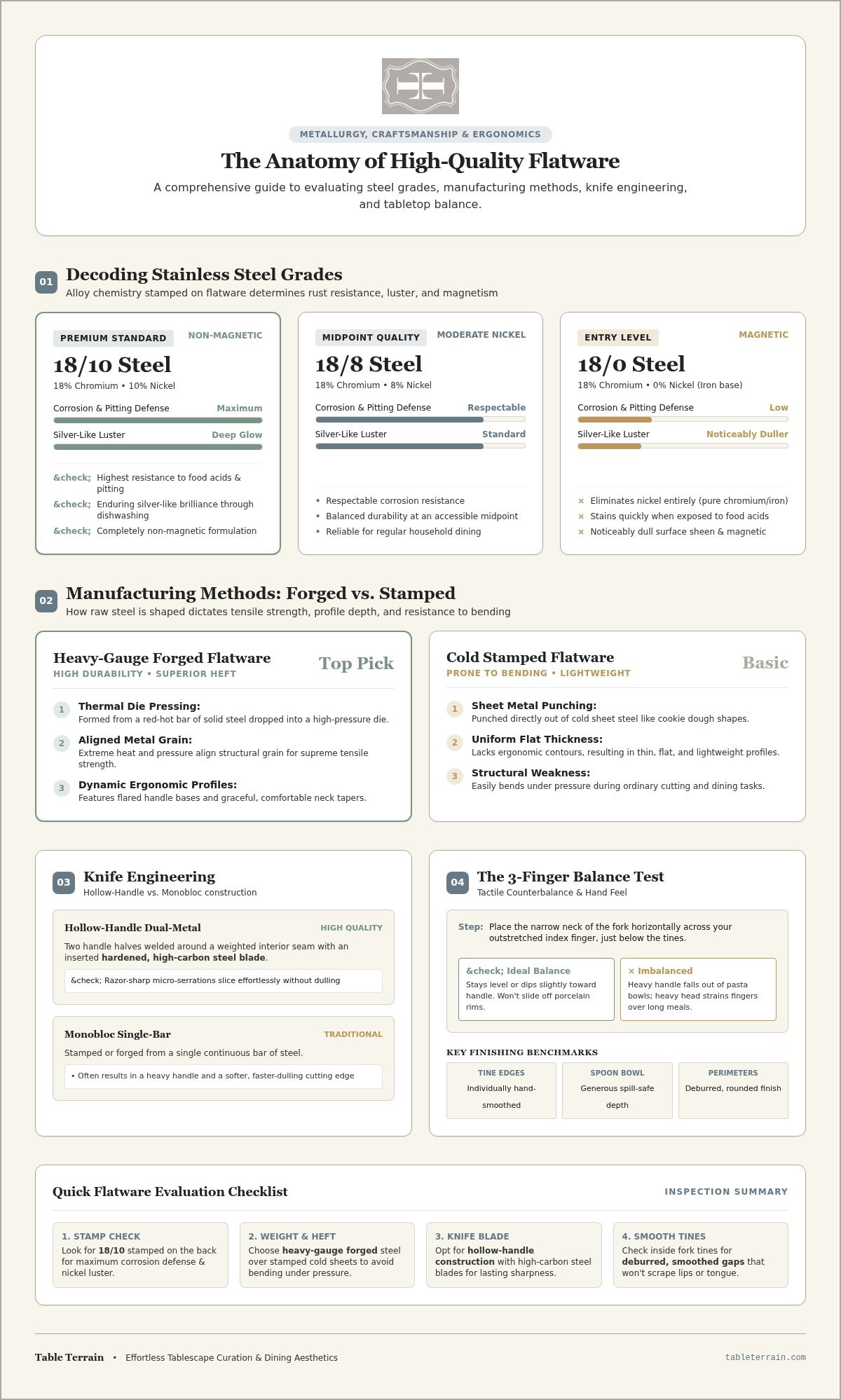
Standard numbers stamped into the back of your fork reveal its baseline metallurgical integrity. In 18/10 stainless steel, the formula contains 18% chromium for rust resistance and 10% nickel for enduring luster and corrosion defense. As documented in the history of cutlery and flatware, alloy composition dictates how metals withstand household acids and frequent washings.
- 18/10 Stainless Steel: Features 18% chromium and 10% nickel. It yields the highest resistance to pitting, retains a deep silver-like glow, and remains entirely non-magnetic.
- 18/8 Stainless Steel: Contains 18% chromium and 8% nickel. It offers respectable corrosion resistance at an accessible midpoint.
- 18/0 Stainless Steel: Eliminates nickel entirely, leaving 18% chromium and iron. It is magnetic, feels noticeably duller, and stains quickly when exposed to everyday food acids.
Forged vs Stamped Flatware: Durability and Heft
How makers shape that steel matters just as much as the alloy recipe. Forged flatware begins as a red-hot bar of solid steel dropped into a high-pressure die. This intense heat and pressure aligns the metal grain, producing dense profiles with flared handle bases and graceful neck tapers. Stamped cutlery, by contrast, is punched directly from cold sheet metal like cookies from dough. Stamped pieces end up uniform in thickness, light in hand, and shockingly prone to bending under slight resistance.
Knife Construction: Hollow Handle vs Monobloc Blades
A table knife requires far more technical engineering than a spoon. Traditional monobloc knives are stamped or forged from a single bar of steel, often making the handle heavy and the cutting edge soft. High quality flatware frequently uses hollow-handle construction. Craftsmen weld two handle halves around a weighted interior seam, then insert a hardened, high-carbon steel blade. This dual-metal approach yields razor-sharp micro-serrations that slice effortlessly through roasted meats without dulling over years of hosting.
Evaluating Ergonomics, Balance, and Hand Feel at the Table
A beautiful fork means nothing if it feels clumsy during a meal. Dining is an intensely tactile ritual, and your cutlery serves as the primary physical bridge to the food you serve. Utensil counterbalance occurs when the weight of the neck and bowl matches the mass of the handle across your index finger, thumb, and middle finger. Without this harmony, wrists tire and utensils slide off porcelain rims. Selecting high quality flatware means looking beyond visual polish to test how pieces actually behave throughout a leisurely dinner.
The Three-Finger Balance Test for Dinner Forks
You don't need lab equipment to test an ergonomic profile. Place the narrow neck of a fork horizontally across your outstretched index finger, just below the tines. A balanced utensil stays level or dips ever so slightly toward the handle. Designs that are overly handle-heavy will immediately topple backward out of wide pasta bowls. Head-heavy forks, conversely, feel clumsy in the palm and drag forward, straining your fingers over multi-course meals.
Tine Geometry, Spoon Bowl Depth, and Edge Finishing
Consumer testing teams at the Good Housekeeping Institute regularly evaluate flatware edges, proving that fine finishing directly impacts mouthfeel and safety. Inspect tines closely under good lighting. Premium cutlery features individually smoothed, deburred inner gaps rather than the raw, sharp edges typical of cheap stamped steel. Similarly, spoon bowls require thoughtful curvature; shallow profiles spill broth over rims, while overly steep bowls make tasting awkward.
- Hand-smoothed tine edges: Prevent uncomfortable scraping against lips and tongue.
- Generous soup bowl depth: Holds liquid securely from bowl to mouth without dripping.
- Softly rounded perimeters: Eliminate rough burrs left behind by rapid metal cutting.
Handle Width and Tactile Comfort
Handle geometry dictates whether a piece feels luxurious or fatiguing. Extremely thin, pencil-like stems may look sleek on social feeds, but they dig into palms when cutting hearty vegetables. Forged pieces offer a thicker spine at the transition point, preventing bending while providing a supportive resting spot for your index finger. Flared or gently arched profiles sit naturally in the palm, accommodating both the American zigzag method and traditional European dining techniques.
When curating your collection, explore balanced high quality flatware and serving items that harmonize practical dining comfort with striking tabletop proportion.
Flatware Finishes and Styling: Mirror, Satin, and PVD Coatings
The finish of your cutlery establishes the entire aesthetic mood of your table. While steel chemistry guarantees strength, the exterior treatment dictates how light dances across your place setting and how much maintenance you face after hosting. From glistening candlelit dinners to laid-back weekend brunches, selecting high quality flatware means choosing a surface treatment engineered to hold its beauty against years of meal prep and cleanups.
Classic Mirror Polish vs Modern Matte Satin
Traditional mirror polish remains the gold standard for formal dining. High-buff mechanical wheels create a liquid-like reflection that bounces candlelight beautifully, according to Britannica in its review of metal finishing traditions. The tradeoff? Mirror surfaces show fingerprints quickly and reveal fine contact marks over time, though occasional passes with a microfiber cloth restore their original gleam. Brushed satin finishes, meanwhile, soften overhead glare. Their micro-textured grain diffuses light, effortlessly disguising superficial hairline scratches and pairing naturally with stonewashed linens.
PVD Technology vs Decorative Electroplating
Not all colored cutlery performs equally under real dining conditions. Cheap gold or matte black sets rely on cosmetic electroplating, a thin chemical wash that flakes off against ceramic plates within months. Premium modern makers utilize Physical Vapor Deposition (PVD). This process vaporizes specialized titanium alloys in a vacuum chamber, bonding them to the steel substrate at a molecular level.
- PVD coatings: Produce ultra-hard, scratch-resistant finishes that bond directly to the metal core.
- Electroplated layers: Sit loosely on the surface, chipping rapidly along fork tips and knife edges.
- Aesthetic longevity: High-grade PVD maintains uniform color depth through hundreds of commercial cleaning cycles.
Dishwasher Safety and Long-Term Surface Maintenance
Even resilient finishes require smart washing habits to retain their lustrous depth. Avoid lemon-scented or citrus-based detergents; harsh citric acids etch protective oxide layers, causing chemical discoloration. Never mix genuine sterling silver and stainless flatware in the same basket. Placing dissimilar metals side by side triggers galvanic corrosion, pitting your steel permanently. For spotless results, load fork tines and spoon bowls upward, run a normal heated dry cycle, and wipe away residual mineral droplets with a soft cotton towel before storing.
Selecting Essential Flatware Configurations and Serving Items
Few hosting moments feel more frantic than washing forks between dinner and dessert. A thoughtful tabletop layout anticipates the flow of courses and gives guests the exact implements they need. Investing in high quality flatware means planning your counts and coordinating shared utensils so you spend your evenings enjoying your guests rather than scrubbing dishes at the kitchen sink.
Anatomy of the 5-Piece Place Setting
The classic 5-piece setting forms the foundation of modern dining. It features a salad fork for crisp starters, a larger dinner fork for entrees, and a balanced dinner knife suited for slicing proteins. Two spoons complete the arrangement: a smaller teaspoon for morning coffee or layered parfaits, and a broader soup or dessert spoon. Depending on your menu, pairing this core setup with individual butter spreaders resting across bread plates keeps sauces and cultured spreads neat.
Essential Host Serving Pieces to Match Your Cutlery
Nothing breaks the visual continuity of a shared feast faster than tossing cheap plastic utensils into an artfully arranged roast platter. Complete your service by pairing your place settings with dedicated host serving items executed in identical finishes.
- Pierced and solid serving spoons: The solid bowl handles creamy grains and sauces, while the slotted counterpart drains roasted vegetables and braised greens.
- Carving and meat forks: Long, sturdy tines steady roasts and poultry without slipping during tableside slicing.
- Sauce ladles and pastry servers: Deep ladle bowls prevent tablecloth drips, and angled spatulas lift delicate tarts cleanly.
Sizing Your Service: Everyday Use vs Dinner Parties
Standard retail boxed sets generally provide service for 4 (20 pieces) or 8 (40 pieces). If you enjoy entertaining, aim for a service of 12. Hosting eight guests for a multi-course dinner burns through salad forks, dinner forks, and dessert spoons before the meal concludes. Having backup place settings accommodates cycle delays between dishwasher runs. Prioritize open-stock patterns so you can readily replace an errant teaspoon without buying an entire replacement box.
Ready to build a cohesive dining collection? Explore high quality flatware and coordinating serving items designed to handle every course with effortless poise.
Styling High Quality Flatware on a Designer Tablescape
Cutlery does more than cut and spoon. It acts as the metallic bridge uniting your linens, dinnerware, and stemware into a harmonious composition. When metal tones play intentionally against surrounding textures, your dining room transforms from a simple meal setting into an inviting sensory experience. Positioning your high quality flatware thoughtfully anchors the table, welcoming guests with effortless visual depth before the first course ever leaves the kitchen.
Pairing Cutlery Finishes with Linens and Placemats
Texture contrast creates effortless tabletop elegance. Warm brushed gold cutlery pairs gorgeously with the organic slubs of raw linen runners and deep earth-toned napkins. If you love a classic mirror shine, set it against textured, woven placemats to soften the reflection while highlighting clean steel lines. To explore how fabric weights and textures elevate your foundational layout, review The Ultimate Guide to Table Linens and Napkin Rings. For broader placement etiquette and dynamic layouts, turn to Elegant Table Settings: 2026 Guide to Hosting.
Balancing Flatware Proportions with Glassware and Vases
Scale and weight distribution dictate how balanced your table feels to incoming diners. Delicate, paper-thin wine glasses look disconnected if placed beside clunky, oversized tools. Instead, anchor slender crystal stems with sculpted, forged dinner knives and forks that hold their own visual ground. Echo colored glassware tones across your metallic details; rich amber or emerald vessels sparkle alongside warm gold cutlery accents. Discover how colored vessels anchor your spread by visiting The Green Goblet Buying Guide.
- Harmonize scale: Pair tall glassware with full-length dinner knives to maintain proportional vertical balance.
- Ground centerpiece vessels: Flank ceramic vases and floral containers with lustrous flatware to bounce ambient light.
- Echo warm undertones: Match amber water goblets with soft satin champagne finishes.
Curating the Complete Table Experience with Table Terrain
Hosting memorable gatherings shouldn't involve hunting across dozens of specialty shops to find matching tones. Seamless tablescapes emerge when every element speaks the same design language. Refresh your host mindset with Mastering the Art of Stunning Table Scapes. When you're ready to set an unforgettable dinner party, discover curated tableware, placemats, and coordinating flatware and serving items designed to make entertaining easy, relaxed, and unmistakably beautiful.
Elevate Your Dining Experience with Cutlery Built to Last
Every unforgettable dinner party balances effortless hospitality with deliberate craft. By choosing 18/10 forged steel, testing balance points across your fingers, and matching durable PVD finishes to your dining aesthetic, you protect yourself against bent forks and dull blades. Genuine high quality flatware anchors your gathering, giving family and friends a comfortable, tactile connection to every dish you share.
Hosting should feel joyful, never stressful. When your cutlery, placemats, and glassware harmonize into a complete tabletop ecosystem, setting an impressive table becomes second nature. Take the guesswork out of hosting your next gathering. Explore curated flatware and dining accessories at Table Terrain to discover premium pieces tested for lasting everyday entertaining.
Frequently Asked Questions
Is 18/10 stainless steel flatware really worth the extra investment?
Yes, 18/10 stainless steel is well worth the investment because it protects against pitting, rust, and dullness. The 10% nickel content creates an impenetrable barrier against food acids while delivering a lustrous, silver-like glow. Budget 18/0 options lack nickel entirely, causing them to stain easily and look cloudy after repeated wash cycles. Choosing 18/10 ensures your table settings stay vibrant for decades.
Can high quality flatware go in the dishwasher safely?
Most high quality flatware is completely dishwasher safe, provided you avoid harsh cleaning habits. Use non-citrus, chlorine-free detergents that won't etch the protective chromium oxide layer. Place forks and spoons with heads pointing upward in the basket to guarantee proper water circulation. Remove and hand-dry pieces immediately after the final rinse cycle to stop hard water mineral spots from settling on the metal.
What is the main difference between forged and stamped flatware?
Forged flatware is shaped from a heated bar of solid metal, while stamped flatware is punched out of a flat sheet. Forging produces varied thicknesses, creating a heavier handle, a reinforced neck, and balanced heft. Stamped flatware remains uniform in thickness from tip to base. This leaves stamped forks light, flimsy, and prone to bending when piercing dense roasted foods.
Will matte black or gold PVD flatware scratch or peel over time?
Authentic Physical Vapor Deposition (PVD) coatings will not peel, flake, or blister because the finish is bonded to the steel in a vacuum at a molecular level. While poor-quality electroplating wears away within months, PVD stands up to daily dining and washing. Avoid abrasive scrubbing pads or stacking items carelessly in metal baskets to prevent fine surface scratches from dulling the satin sheen.
How many flatware place settings should a host actually own?
A host who entertains regularly should own a service for 12, consisting of complete 5-piece settings. This provides enough cutlery for an eight-person dinner party spanning multiple courses without forcing you to wash utensils between salad and dessert. It also creates a safety buffer for cycle delays in the dishwasher and covers missing pieces when teaspoons inevitably go astray.
What causes rust spots on stainless steel cutlery after dishwashing?
Rust spots usually stem from foreign iron particles deposited during the wash cycle rather than the flatware itself degrading. Leaving acidic foods like mustard or tomato sauce on utensils overnight can also eat away the passive surface layer. In addition, washing stainless pieces right next to chipped, cast-iron pans or genuine silver cutlery triggers galvanic reactions that leave brown surface marks behind.
How do I choose between modern satin and traditional mirror finishes?
Choose mirror finishes if you frequently host candlelit, formal dinners where you want light reflecting across the table. Select satin or matte finishes if you prefer a contemporary, relaxed look for casual entertaining. Satin finishes excel at masking everyday fingerprints and minor hairline scratches, making them especially practical for hosts who favor organic linens and textured stoneware settings.